The $500 Billion Cloud Cost Problem
Global enterprise spending on cloud infrastructure has now crossed an annualized rate of half a trillion dollars, according to Synergy Research Group. Total public cloud services spending is on pace to exceed a trillion dollars in 2026, with growth above 21% year over year, driven by application modernization, AI adoption, and demand for scalable digital infrastructure.
The uncomfortable part of that growth story is waste. Industry research consistently puts cloud waste at roughly 30-35% of total spend, which at global scale works out to somewhere in the range of $300 billion to $350 billion wasted every year. Put simply: for every three dollars an enterprise spends on cloud, close to one dollar delivers no business value at all.
This isn’t a niche operational problem — it’s a budget-line problem, a governance problem, and increasingly, a boardroom problem. And it’s exactly the gap Cloud Cost Optimization is built to close.
What Cloud Cost Optimization Really Means
As cloud adoption grows, so does the complexity of managing its cost. Organizations routinely face unexpected spikes in cloud bills, a lack of visibility into where spend is actually going, and inefficient use of the resources they’re already paying for. Multi-cloud environments compound the problem further, scattering billing and monitoring across disconnected systems.
Ask most engineering or finance leaders a few simple questions, and the hesitation is telling:
- Where is our cloud budget actually being spent?
- Are we overpaying for resources that sit underutilized?
- Can we predict and control future cloud expenses before they surprise us?
- How do we optimize spend without putting performance at risk?
Cloud Cost Optimization isn’t a single dashboard or a one-time audit. It’s a continuous discipline — combining visibility, forecasting, recommendations, and automation into a system that keeps cloud spend aligned with actual business value, on an ongoing basis rather than after the invoice arrives.
Cavisson’s 4-Step Cloud Cost Optimization Framework
Cavisson’s approach is built around four connected capabilities that work together as a single framework, not as isolated tools:
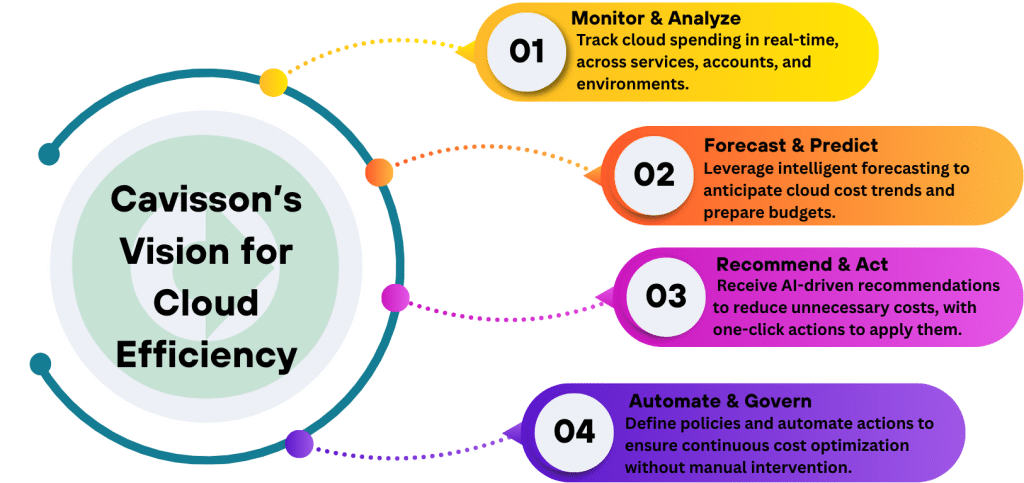
- Monitor & Analyze — Track cloud spending in real time, across services, accounts, and environments, so cost data is never a black box.
- Forecast & Predict — Apply intelligent forecasting built on historical usage trends, seasonal variations, and consumption patterns to anticipate cost trends and plan budgets with confidence.
- Recommend & Act — Receive AI-driven, infrastructure-specific recommendations to cut unnecessary spend, with one-click actions to apply them immediately.
- Automate & Govern — Define policies that keep optimization running continuously, without requiring manual intervention every time a resource drifts out of line.
Together, these four steps move cost management from a reactive, after-the-fact exercise into a proactive, continuous system of control.
The Six Pillars of Intelligent Cloud Cost Optimization
Underneath that framework sits a set of purpose-built capabilities:
- Forecasted Cloud Spend — Predicts upcoming expenses using historical patterns, seasonal variation, and service consumption trends, so budgeting stops being guesswork.
- Multi-Level Cost Breakdown & Drilldowns — Analyzes costs with granular drilldowns across services, instances, regions, accounts, or time frames.
- Tag & Pool-Based Cost Allocation — Groups and allocates costs by project, team, business unit, or department using smart tagging and pools, driving real accountability and visibility.
- Idle & Underutilized Resource Detection — Automatically detects and flags unused or underutilized resources — EC2, EBS, RDS, and more — that quietly drain budget without delivering value.
- Recommendations & Actions — Delivers cost-saving suggestions tailored to actual infrastructure usage, from rightsizing and migration to purchasing plans.
- Custom Alerts & Anomaly Detection — Sets up real-time alerts for unusual spend spikes and proactively monitors patterns to avoid bill shocks.
The platform supports the three major cloud providers — Amazon Web Services, Microsoft Azure, and Google Cloud Platform — making it a practical fit for the multi-cloud reality most enterprises now operate in.
Deep Dive: AWS Cloud Cost Optimization Strategies
Because AWS remains the dominant cloud platform for most enterprises, Cavisson’s recommendations engine goes deep into the specific AWS services that quietly drive up spend:
EBS Optimization — Delete unattached and unused volumes, migrate GP2 to cost-effective GP3, upgrade legacy I01 volumes, right-size over-provisioned IOPS, storage, and throughput, and clean up obsolete snapshots and snapshot chains.
EC2 Instance Optimization — Identify unused or abandoned instances for deletion or scale-down, upgrade old-generation instances, migrate workloads to cheaper regions, schedule shutdowns for inactive instances, convert eligible workloads to spot pricing, and flag long-running instances that should move to Reserved Instances or Savings Plans.
RDS Optimization — Shut down abandoned database instances with zero connections, scale down or shift underutilized instances to Aurora, upgrade databases running on costly extended-support engine versions, and purchase Reserved Instances for databases that have outgrown on-demand pricing.
S3 Storage Optimization — Apply lifecycle policies to transition or delete aging data, enable intelligent tiering, and remove abandoned buckets with minimal usage.
Redshift & ElastiCache Optimization — Delete unused or underutilized clusters, clear out old manual snapshots, and purchase reserved capacity for steady, long-running workloads.
Other AWS Services — Extend the same discipline to Amazon MQ, ECR, OpenSearch, DynamoDB, Auto Scaling Groups, and Kinesis Streams, plus identify opportunities to migrate x86 workloads to more cost-efficient Graviton instances.
This level of service-by-service granularity is what separates a real cost optimization platform from a generic billing dashboard.
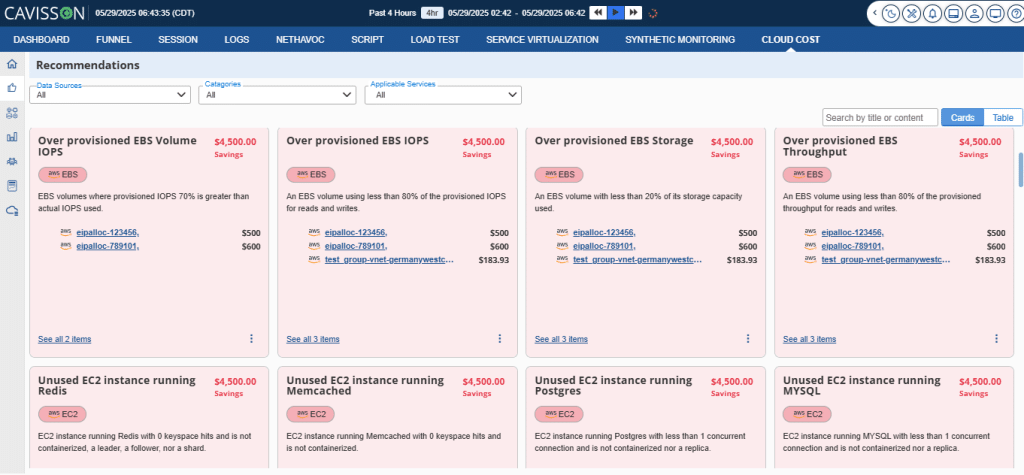
Cavisson’s Recommendations view puts this into practice — surfacing specific, dollar-quantified opportunities like over-provisioned EBS volumes and unused EC2 instances running Redis, Memcached, Postgres, or MySQL, each tied to the exact resource ID and potential savings.
Automation: The Future of Cloud Cost Governance
Detection and recommendations only go so far without the ability to act on them automatically. Cavisson’s automation capabilities close that gap by handling four core actions without waiting on a human to intervene:
- Scheduling termination of unused resources
- Auto-tagging for chargeback and cost allocation
- Resizing instances based on real load patterns
- Applying lifecycle policies for storage automatically
This is where cloud cost governance is heading — from periodic manual cleanups to policy-driven systems that keep optimizing continuously, in the background, every day.
Business Benefits Across Finance, DevOps, and Leadership
The value of Cloud Cost Optimization lands differently depending on who’s looking:
For Finance & Ops — Predictable and controlled cloud budgets, along with transparent chargeback and accountability across teams.
For DevOps — More time focused on innovation instead of manual cost management, with intelligent sizing that avoids over-provisioning in the first place.
For Executives — Reduced cloud spend by up to 30%, along with real confidence in the organization’s cloud investment strategy.
At the business level, that adds up to a lower total cost of ownership, improved resource efficiency, and a sustainable path for cloud growth — benefits that show up on the balance sheet, not just the infrastructure bill.
Why Cloud Optimization Is a Business Strategy — Not Just Cost Savings
Cloud waste is a symptom. Visibility, accountability, and automation are the cure. Cloud Cost Optimization empowers organizations to control runaway costs, align cloud usage with business goals, and enable smarter engineering decisions — not simply to trim a bill after the fact.
Given that global cloud waste runs into the hundreds of billions of dollars annually, treating cost optimization as an occasional cleanup task is no longer viable. It has to be built into how cloud infrastructure is run, day to day. Cloud cost optimization isn’t optional — it’s strategic.
Final Thoughts
The cloud has become the backbone of enterprise IT, and its cost has become one of the largest and least controlled line items on the budget. Closing that gap doesn’t require spending less on cloud — it requires spending smarter, with the visibility, forecasting, automation, and accountability to know exactly where every dollar goes.
That’s the problem Cavisson’s Cloud Cost Optimization solution was built to solve: turning cloud waste from an accepted cost of doing business into a controllable, continuously optimized part of the infrastructure strategy.