

What Is Service Virtualization?
Service virtualization is the practice of simulating the behavior of dependent components — APIs, databases, mainframes, third-party services — that an application under test relies on but cannot always access. These simulations, often called virtual services or stubs, mimic the real service’s responses, behavior, and even its failure modes.
Unlike traditional mocking (which is code-level and tightly coupled to unit tests), service virtualization operates at the network or protocol level. It intercepts actual calls made by your application and returns realistic, configurable responses — without ever touching the real service.
Think of it as a flight simulator for your software. Pilots don’t learn to fly by immediately taking real aircraft into turbulent skies. They train in simulators that faithfully replicate real conditions. Service virtualization gives your QA teams and developers the same advantage: a safe, controllable, always-available environment that behaves like production.
The Hidden Cost of Dependency Bottlenecks
Before we explore how service virtualization works, it is worth understanding how expensive the alternative really is.
Test environment unavailability is one of the most underreported productivity killers in software organizations. Consider a typical enterprise development team:
- A shared QA environment goes down for maintenance. Dozens of testers are blocked for hours or days.
- A third-party payment API has rate limits that prevent realistic load testing.
- A partner’s sandbox environment behaves inconsistently, producing flaky test results that erode trust in the test suite.
- A downstream microservice being built by another team isn’t ready, so integration testing is postponed — often indefinitely.
- A legacy mainframe is only available during specific business hours, throttling offshore teams entirely.
Each of these scenarios translates directly into delayed releases, increased costs, and — most dangerously — reduced test coverage. Teams under deadline pressure skip tests they cannot run, and defects slip into production as a result.
Industry research consistently shows that the cost of fixing a defect rises dramatically the later it is discovered in the software lifecycle. A bug caught in development costs a fraction of one found in production. Service virtualization is not just a convenience — it is a risk mitigation strategy with measurable return on investment.
How Service Virtualization Works
A service virtualization platform typically works in one of two ways:
Recording and Playback: The tool acts as a transparent proxy between your application and the real service, recording actual request-response pairs during an initial learning phase. These recordings are then replayed as virtual services during testing — with no real service required.
Behavior Modeling: Engineers define the virtual service’s behavior explicitly, specifying how it should respond to different inputs, edge cases, error conditions, and latency profiles. This is especially powerful for testing scenarios that the real service may not support — such as timeout errors, network failures, or rare data conditions.
Modern service virtualization platforms support a wide range of protocols: REST, SOAP, GraphQL, gRPC, MQ messaging, database queries, and more. They integrate directly into CI/CD pipelines, making virtual services a first-class citizen of the automated testing workflow.
Five Transformative Benefits of Service Virtualization
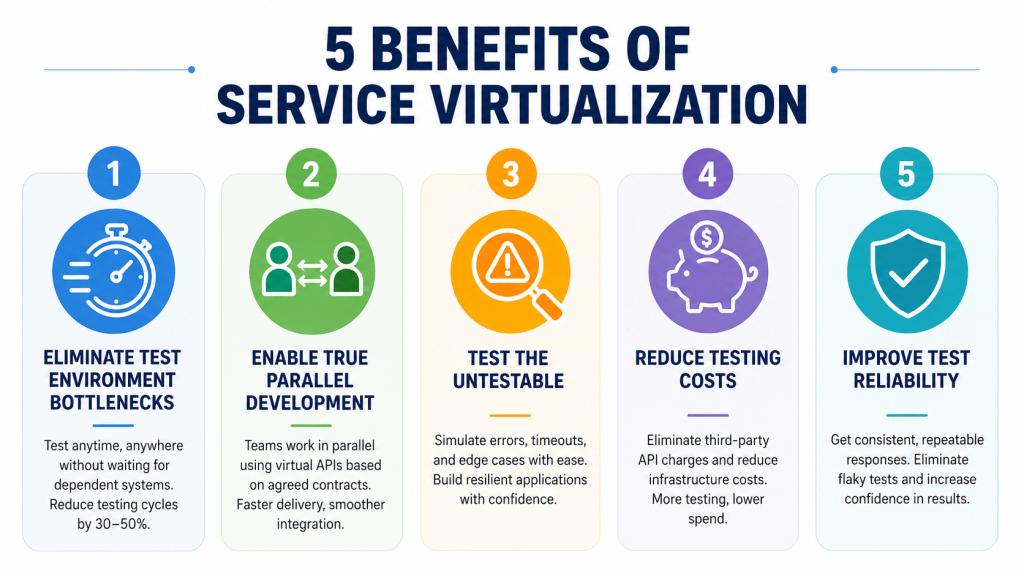
1. Eliminate Test Environment Bottlenecks
With virtual services, your testing is no longer hostage to the availability of external or downstream systems. QA teams can run full integration test suites at any time — on weekends, during off-hours, across time zones — without waiting for shared environments to be provisioned or third-party sandboxes to respond. This single benefit alone can compress testing cycles by 30 to 50 percent in large enterprises.
2. Enable True Parallel Development
In microservices and API-first architectures, teams building different services often block each other. Team A cannot test their service until Team B finishes building the service it depends on. Service virtualization shatters this constraint. Team A creates a virtual representation of Team B’s forthcoming API — based on agreed contract specifications — and proceeds with full integration testing immediately. Both teams move in parallel, and integration is smooth because the contract was validated continuously throughout development.
3. Test the Untestable
Some scenarios are nearly impossible to reproduce with real services. What happens when the payment gateway times out after 29 seconds? What does your application do when the inventory service returns a corrupted response? How does the system behave under a sudden 5x surge in API latency? With service virtualization, you define these conditions explicitly and test against them repeatedly. Edge cases, error conditions, and failure scenarios become routine parts of your test suite rather than post-incident discoveries.
4. Reduce Testing Costs Significantly
Third-party API calls cost money. High-volume load tests against paid external services can generate significant API charges — and most providers do not offer unlimited sandbox access. Service virtualization eliminates these costs entirely for testing purposes. Similarly, provisioning and maintaining multiple shared test environments is expensive in terms of infrastructure and operations. Virtual services require a fraction of the resources.
5. Improve Test Reliability and Repeatability
Flaky tests are the bane of every QA team. When a test fails because a downstream service was slow, not because the application under test had a bug, you have wasted time and eroded confidence in your test suite. Virtual services respond consistently, deterministically, and with precisely the latency and behavior you configure. Your tests become reliable signals of application quality rather than noise generated by environmental instability.
Service Virtualization and Performance Testing: A Powerful Combination
At Cavisson Systems, we have long understood that performance testing and service virtualization are natural partners.
Load testing an application that depends on real third-party services is inherently problematic. You cannot generate 10,000 concurrent users hitting a production payment API. You cannot simulate a database that degrades gracefully under load while observing how your application responds. You cannot accurately measure your application’s own performance characteristics when its behavior is intertwined with the response times and error rates of external dependencies.
By coupling service virtualization with performance testing, teams gain something transformative: the ability to isolate their application’s performance from its dependencies. You can configure virtual services to respond with realistic latency distributions, introduce artificial slowdowns, simulate dependency degradation, and measure precisely how your application behaves under each condition.
This is how serious performance engineering is done. Not by hoping the real services cooperate during a load test window, but by controlling every variable in the testing environment.
Service Virtualization in a CI/CD World
Modern software delivery depends on fast, automated pipelines. Every commit should trigger a comprehensive suite of tests. But if those tests depend on external services, they introduce unpredictability, latency, and failure modes that have nothing to do with the code being tested.
Service virtualization integrates cleanly into CI/CD pipelines. Virtual services can be spun up automatically as part of a pipeline stage, tests execute against them in a controlled environment, and the pipeline receives a reliable pass or fail signal based solely on the application’s behavior. Pipeline execution times drop. False failures disappear. Developer confidence in the pipeline improves — which means developers actually trust and act on pipeline results rather than dismissing failures as “probably an environment issue.”
Getting Started: A Practical Approach
Organizations new to service virtualization typically begin with a focused pilot:
Identify the biggest pain point. Which dependency most frequently blocks your testing? Which third-party service is most rate-limited, most unreliable, or most expensive to call during testing? Start there.
Record real interactions. Deploy a virtual service platform in recording mode between your application and the real service. Capture a representative set of interactions covering your key test scenarios.
Validate the virtual service. Run your existing tests against the virtual service and compare results to runs against the real service. Tune response behavior until parity is achieved.
Expand coverage. Add edge cases, error conditions, and performance scenarios that the real service does not support. This is where service virtualization delivers its most unique value.
Integrate into CI/CD. Automate virtual service deployment as part of your pipeline. Make reliable integration testing the default, not the exception.
Cavisson’s Perspective: Testing Without Limits
At Cavisson Systems, our mission has always been to give engineering teams complete visibility and control over application performance and quality. Service virtualization aligns perfectly with that mission.
The most sophisticated performance engineering practices in the world are undermined when teams cannot control their test environments. When testing is constrained by dependency availability, teams make compromises: they test less frequently, with less coverage, under less realistic conditions. Those compromises accumulate into production incidents, customer-facing failures, and emergency remediation efforts that dwarf the cost of investing in proper testing infrastructure.
Service virtualization removes those constraints. It gives teams the freedom to test continuously, comprehensively, and confidently — regardless of what external dependencies are doing.
For organizations running complex microservices architectures, integrating with multiple third-party platforms, or operating in regulated industries where test environment provisioning is bureaucratically complex, service virtualization is not a nice-to-have. It is foundational.
Conclusion
Service virtualization is the infrastructure that makes modern testing strategy possible at scale. It eliminates the dependency bottlenecks that slow teams down, enables parallel development, makes edge cases testable, reduces costs, and delivers the test reliability that CI/CD pipelines demand.
The teams that embrace service virtualization are not just testing faster — they are testing better. They catch more defects earlier, ship with more confidence, and spend less time firefighting production issues.
The question is no longer whether service virtualization is worth adopting. The question is how much longer your organization can afford to test without it.
Cavisson Systems is a leader in performance engineering and application quality solutions. Our platforms empower enterprises to test smarter, scale confidently, and deliver exceptional digital experiences. To learn how Cavisson can help your organization implement service virtualization and elevate your testing strategy, contact our team today.