

Software testing has a dependency problem. Every time your team needs to test a feature, they’re often blocked—waiting for a third-party API to be available, a mainframe system to be provisioned, or a partner’s sandbox environment to be unlocked. These delays don’t just slow down testing; they quietly drain budgets through idle engineering hours, extended project timelines, and expensive infrastructure that sits underutilized outside business hours.
Service virtualization solves this problem at its root. By simulating the behavior of dependent systems—APIs, databases, mainframes, and third-party services—teams can test early, test often, and test without waiting. Organizations that adopt service virtualization report cost reductions of up to 70%, and the reasons why are refreshingly practical.
The Real Cost of Dependency-Driven Testing
Before looking at solutions, it’s worth understanding exactly where the money goes in traditional testing environments.
1. Environment Provisioning and Maintenance
Setting up realistic test environments that mirror production—complete with third-party integrations, legacy systems, and partner APIs—is expensive. These environments require dedicated infrastructure, licensing fees for enterprise systems, and specialized teams to maintain them.
Typical costs include:
- Cloud or on-premises infrastructure running 24/7, even when testing happens only during business hours
- Software licenses for systems like SAP, mainframes, or specialized payment gateways
- Dedicated environment management teams
2. Third-Party API and Service Access Fees
Many organizations pay per-transaction fees to access sandbox environments for payment gateways, credit bureaus, shipping calculators, or fraud detection services. Every test run against these live sandboxes adds up—and rate limits often throttle how much testing you can actually do.
3. Idle Time and Scheduling Conflicts
When multiple teams share the same limited test environments, testing becomes a scheduling exercise. QA teams wait for their turn on a shared mainframe. Developers wait for a partner’s API to come back online after maintenance. This idle time is rarely tracked, but it represents pure lost productivity.
4. Delayed Defect Discovery
When testing is blocked or limited, defects often aren’t discovered until later in the development cycle—sometimes not until UAT or production. The cost of fixing a bug increases dramatically the later it’s found, turning what could have been a quick fix into an expensive emergency patch.
5. Parallel Development Bottlenecks
In modern agile and DevOps environments, multiple teams need to work simultaneously. Without virtualized dependencies, teams building interconnected services must wait for each other’s components to be ready, creating a chain of delays that compounds across the project.
What Is Service Virtualization?
Service virtualization creates realistic, configurable simulations of the systems your application depends on—without requiring the real system to be present. Instead of connecting to an actual payment gateway, mainframe, or third-party API, your tests interact with a virtual service that mimics its behavior, responses, and even its performance characteristics.
Think of it as a stunt double for your dependencies. The virtual service looks, behaves, and responds just like the real thing, but it’s available on-demand, free of transaction fees, and fully within your control.
Service virtualization typically covers:
- REST, SOAP, and GraphQL APIs
- Mainframe and legacy system interfaces
- Message queues and event-driven systems
- Databases and data services
- Third-party services (payment gateways, shipping providers, credit checks, fraud detection)
How Service Virtualization Cuts Testing Costs
1. Eliminate Infrastructure and Licensing Costs
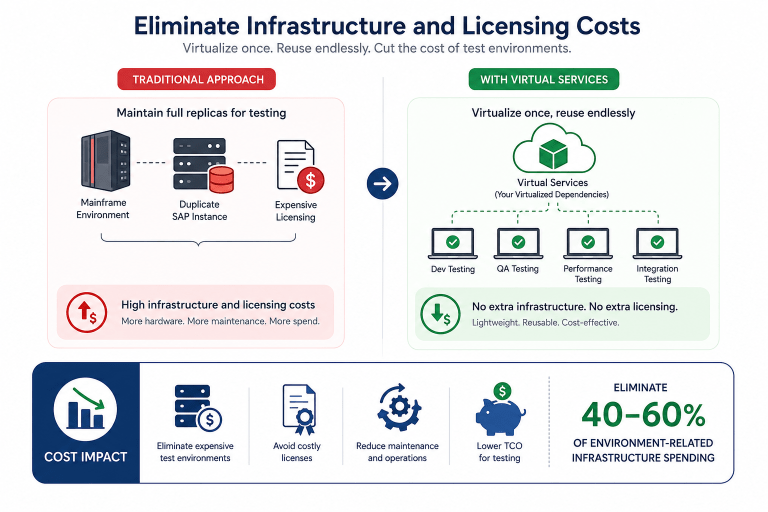
Instead of maintaining expensive replicas of production systems for testing, teams virtualize the dependency once and reuse it indefinitely. There’s no need to license a full mainframe environment or maintain a duplicate SAP instance purely for test purposes.
Cost impact: Organizations often eliminate 40-60% of environment-related infrastructure spending by replacing physical test environments with lightweight virtual services.
2. Remove Third-Party Transaction Fees
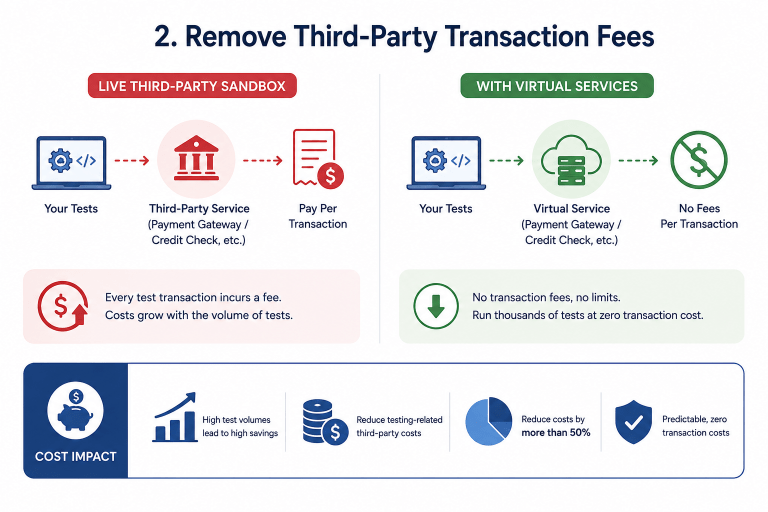
Virtual services don’t charge per transaction. Teams can run thousands of test iterations against a virtualized payment gateway or credit check service without incurring the fees associated with live sandbox usage.
Cost impact: For organizations running high volumes of automated tests, this alone can reduce testing-related third-party costs by more than half.
3. Enable Parallel Testing Without Conflicts
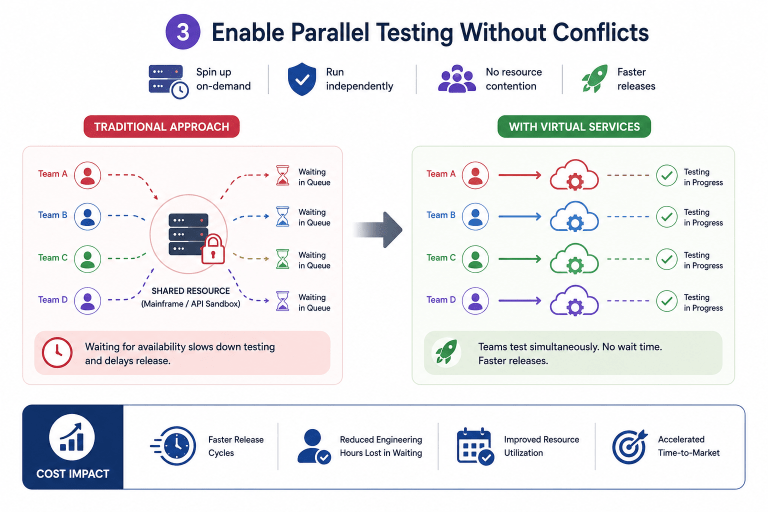
Because virtual services can be spun up on-demand and run independently, multiple teams can test simultaneously without competing for shared resources. There’s no more waiting for the mainframe to free up or the shared API sandbox to be available.
Cost impact: Parallel testing capability directly translates to faster release cycles, reducing the engineering hours spent waiting and accelerating time-to-market.
4. Shift Testing Earlier in the Development Cycle
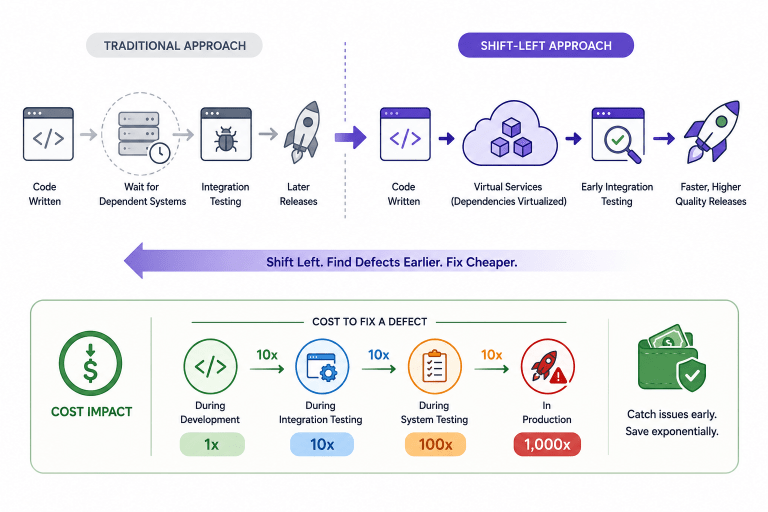
With dependencies virtualized, teams can begin integration testing as soon as code is written—long before the real dependent systems are available. This “shift-left” approach catches defects when they’re cheapest to fix.
Cost impact: Industry research consistently shows that fixing a defect in production costs 10-100 times more than fixing it during development. Catching issues earlier through service virtualization directly reduces this expensive category of spending.
5. Reduce Environment Downtime Impact
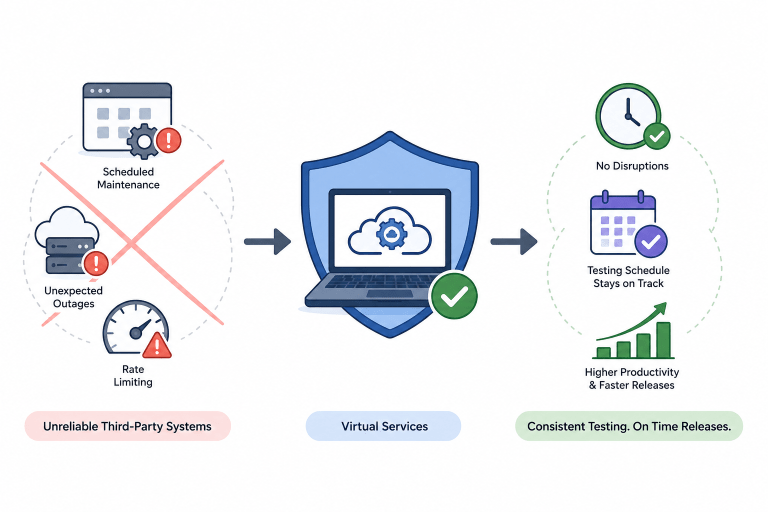
Third-party systems go through scheduled maintenance, unexpected outages, and rate limiting. When your tests depend on virtual services instead of live systems, these disruptions no longer stall your testing schedule.
Cost impact: Teams recover the productivity previously lost to unpredictable third-party downtime, keeping testing schedules—and therefore release schedules—on track.
6. Simplify Complex Scenario Testing
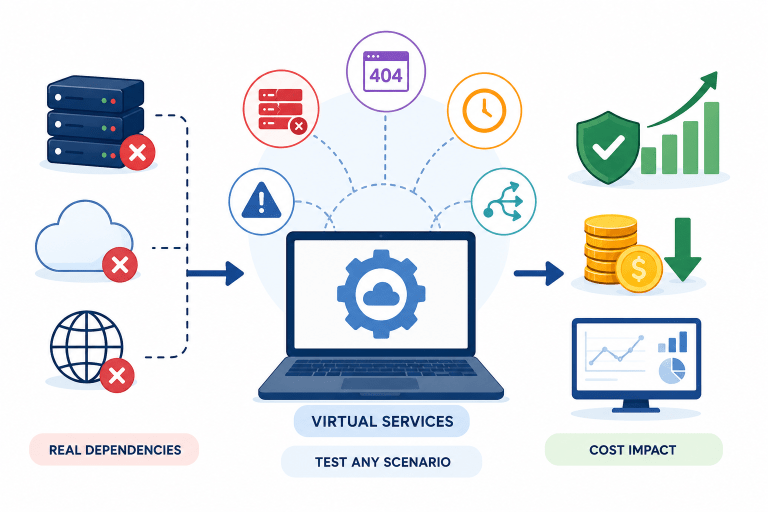
Testing edge cases like system failures, timeouts, or unusual response codes is difficult and sometimes impossible with real dependencies. Virtual services let you configure exactly the response you need—including failure scenarios—without needing to coordinate with external providers.
Cost impact: This reduces the need for expensive dedicated performance and failure-testing environments while improving test coverage and application resilience.
A Practical Example
Consider a financial services company that integrates with three external systems: a credit bureau, a payment processor, and a fraud detection service. Each of these charges per-transaction sandbox fees and has limited availability outside business hours.
Before service virtualization:
- Testing was limited to business hours due to sandbox availability
- Automated regression suites ran only 2-3 times per week due to transaction fees
- QA teams frequently waited for shared sandbox access
- Average defect discovery happened in later testing phases, requiring costly rework
After service virtualization:
- Automated regression suites run nightly, with unlimited iterations
- Teams test edge cases (timeouts, service failures, invalid responses) that were previously impossible to simulate
- Development and QA teams work in parallel without scheduling conflicts
- Defects are caught during development, well before integration testing
The result: significantly compressed testing timelines, dramatically reduced third-party fees, and a measurable drop in production defects—all contributing to overall testing cost reductions in the range organizations typically report with mature service virtualization adoption.
Where Cavisson Fits In
Cavisson Systems’ service virtualization capabilities are built to integrate seamlessly with your existing testing and performance engineering workflows. Rather than treating virtualization as an isolated tool, Cavisson connects it directly with your broader quality strategy:
- Realistic Simulation: Create virtual services that accurately replicate the behavior, response times, and even failure modes of your real dependencies—so your tests reflect real-world conditions.
- Seamless Integration with Performance Testing: Combine service virtualization with load and performance testing to validate how your application behaves under scale, even when real third-party systems can’t support high test volumes.
- Faster Environment Setup: Reduce the time it takes to stand up complete test environments from weeks to hours, accelerating your testing timelines without sacrificing coverage.
- Centralized Management: Manage virtual services alongside your test scripts, data, and results in a unified platform, avoiding the tool sprawl that often comes with adopting virtualization separately from other testing tools.
- Support for Complex Enterprise Systems: From mainframes to modern microservices, Cavisson’s platform is designed to handle the variety of systems found in real enterprise environments.
Getting Started
Adopting service virtualization doesn’t require an all-or-nothing transformation. Most organizations start by identifying their most expensive or most constrained dependencies—the third-party APIs with high transaction fees, or the shared systems causing the most scheduling conflicts—and virtualizing those first.
From there, expansion follows naturally as teams experience the benefits: faster testing cycles, reduced costs, and the freedom to test scenarios that were previously out of reach.
A simple starting approach:
- Identify high-cost or high-friction dependencies — Look for systems with per-transaction fees, limited availability, or frequent scheduling conflicts
- Virtualize the highest-impact services first — Prioritize based on testing frequency and cost per test cycle
- Integrate virtualization into your CI/CD pipeline — Enable automated testing to run continuously without waiting for live system availability
- Expand coverage over time — Gradually virtualize additional dependencies as your team becomes comfortable with the approach
Conclusion
Testing shouldn’t be held hostage by systems you don’t control. Service virtualization removes the friction, cost, and unpredictability of dependency-driven testing, freeing your teams to test more thoroughly, more frequently, and more affordably.
Organizations that make the shift consistently report substantial reductions in testing-related costs—not through cutting corners, but through eliminating waste: unnecessary infrastructure, unused licenses, avoidable transaction fees, and the hidden cost of idle engineering time.
If your testing process is still waiting on third-party systems, mainframes, or shared sandboxes, it may be time to explore what service virtualization can do for your budget and your release velocity.
Ready to Reduce Your Testing Costs?
See how Cavisson’s service virtualization capabilities can help your team test faster, more thoroughly, and at a fraction of the current cost.
Schedule a Demo → | Talk to an Expert → | Explore Our Testing Suite →