

Introduction
In today’s rapidly evolving software development landscape, delivering high-quality applications requires more than writing code and executing automated tests. Development teams continuously introduce new features, fix vulnerabilities, apply security patches, and modify application components. Every change brings the possibility of introducing unexpected defects.
While traditional testing approaches such as unit testing, integration testing, and regression testing help identify software issues, an important question remains: How effective are your existing test cases at detecting defects? Achieving high code coverage does not necessarily mean that an application is thoroughly tested. A test suite may execute almost every line of code without verifying whether the application produces the correct results.
This is where Cavisson Mutation Testing comes in, helping developers evaluate the effectiveness of their unit tests by introducing controlled changes, known as mutations, into application code. Our IDE extensions simplify mutation testing for .NET and JavaScript applications by automating tool installation, project configuration, test execution, and report uploading to the Cavisson Dashboard. With Cavisson Mutation Testing, development teams can move beyond measuring code execution and gain deeper insights into the actual effectiveness of their unit tests.
What Is Mutation Testing?
Mutation testing is a software testing technique that evaluates the effectiveness of existing test cases by introducing small, intentional changes into application source code. These changes are called mutations, while the modified versions of the original code are known as mutants. The objective is simple: determine whether the existing unit tests can identify these intentionally introduced changes.
For example, consider an application that calculates discounts:
Original Code:
def calculate_discount(price, discount):
return price – (price * discount / 100)
Suppose the application calculates a 10% discount on a product worth ₹1,000. The expected result is ₹900.
Now, imagine changing the subtraction operator to addition.
Mutated Code:
def calculate_discount(price, discount):
return price + (price * discount / 100)
The modified function now returns ₹1,100 instead of ₹900. If the existing test case identifies this incorrect result and fails, the mutant is considered killed. However, if the test passes despite the incorrect implementation, the mutant is considered survived. This indicates a possible weakness in the test suite, such as missing assertions or insufficient test scenarios. By identifying surviving mutants, developers can understand where their tests need improvement.
Why Is Mutation Testing Important?
Traditional code coverage metrics indicate how much of an application’s source code is executed during testing. However, they do not necessarily measure whether the tests validate the application’s actual behavior. Mutation testing addresses this limitation by examining whether test cases can detect deliberately introduced code-level errors.
Some important advantages include:
- Evaluate Test Effectiveness: Determine whether existing unit tests can identify incorrect code changes instead of simply executing application logic.
- Identify Weak Test Cases: Discover missing assertions, insufficient validation, and test scenarios that fail to detect unexpected application behavior.
- Improve Code Quality: Strengthen test cases by identifying areas where additional validation and boundary-condition testing may be required.
- Increase Confidence in Software Changes: Evaluate the effectiveness of unit tests before introducing code changes into subsequent development and release stages.
- Strengthen Regression Testing: Help ensure that automated tests are capable of detecting selected behavioral changes that could otherwise go unnoticed.
Introducing Cavisson Mutation Testing
Cavisson Mutation Testing is a Visual Studio Code extension that simplifies mutation testing for developers working with .NET and JavaScript applications. Instead of manually installing and configuring mutation testing tools, developers can use the Cavisson extension to manage the process directly from their development environment. The extension provides an integrated workflow for configuring projects, executing mutation tests, and uploading generated reports to the Cavisson Dashboard.
Key Capabilities of Cavisson Mutation Testing
- Visual Studio Code Integration: The extension integrates mutation testing capabilities directly into Visual Studio Code, allowing developers to configure and execute mutation tests from their existing development environment.
- Support for .NET and JavaScript: Cavisson Mutation Testing supports:
- .NET applications using .NET SDK 6.0 or higher.
- JavaScript applications using Node.js 14 or higher and NPM.
- Flexible Project Configuration: Developers can create and manage project profiles, select the technology, and specify the application source files or namespaces they want to evaluate.
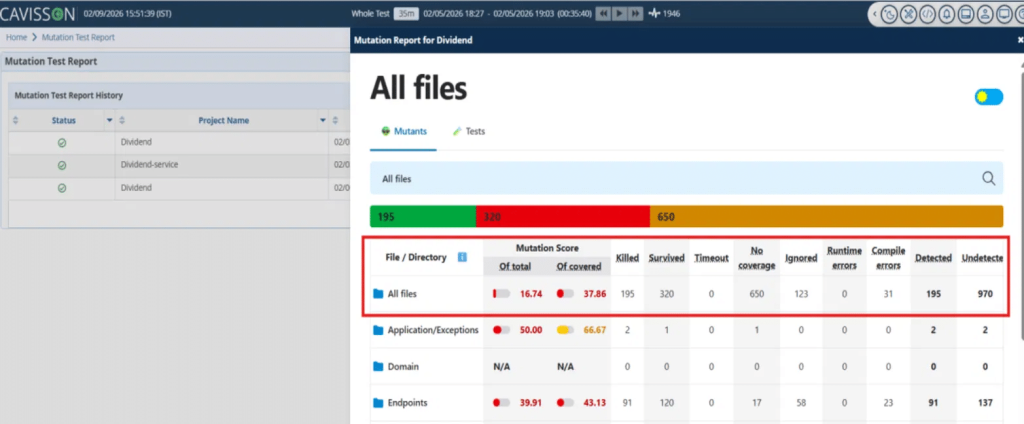
- Centralized Reporting & Result Analysis: Cavisson Mutation Testing automatically uploads generated mutation testing reports to the configured Cavisson Dashboard Server. Developers can access these reports through the dashboard to review mutation testing results, analyze killed and survived mutants, and identify potential gaps in their existing test cases. These insights help developers understand test effectiveness, prioritize improvements, and strengthen their unit testing practices.
Understanding Mutation Testing Results
Mutation testing helps developers identify whether their existing test cases detect the changes introduced into application code.
Two important outcomes are:
- Killed Mutants: The existing test suite successfully identifies the introduced change and fails as expected.
- Survived Mutants: The test suite does not detect the introduced change, indicating a possible gap in test validation.
Surviving mutants provide valuable insights into areas where developers may need to strengthen assertions, add boundary-condition checks, or introduce additional test scenarios. However, not every surviving mutant necessarily indicates a genuine testing weakness. Some mutations may not change observable application behavior. The objective is to investigate meaningful surviving mutations and continuously improve test effectiveness.
How Cavisson Mutation Testing Strengthens Software Quality
At Cavisson Systems, we believe that software quality requires a comprehensive approach that addresses application correctness, performance, reliability, and end-user experience.
Cavisson’s Experience Management Platform brings together capabilities across:
- Performance Testing: Evaluate application performance, scalability, and capacity under defined workloads through NetStorm.
- Application Performance Monitoring: Gain visibility into application performance and identify performance-related issues through NetDiagnostics.
- Service Virtualization: Simulate backend services and dependencies through NetOcean.
- Chaos Engineering: Assess application resilience by introducing controlled failure scenarios through NetHavoc.
Cavisson Mutation Testing complements these capabilities by helping developers identify weaknesses in their existing unit tests and evaluate how effectively they detect code-level defects.
Practical Example: Strengthening an E-Commerce Checkout Application
Consider an e-commerce application where the checkout process involves discount calculations, payment processing, inventory validation, and order confirmation. A developer modifies the discount calculation logic. Although the existing unit tests pass, Cavisson Mutation Testing introduces controlled code changes and identifies that certain incorrect discount calculations remain undetected. This reveals a weakness in the test cases that could allow incorrect pricing behavior to go unnoticed.
However, identifying this code-level weakness is only one part of ensuring application quality. By combining mutation testing with Cavisson’s broader testing and monitoring capabilities, development teams can investigate multiple dimensions of the same business workflow:
- Mutation Testing: Identifies weaknesses in unit tests that fail to detect incorrect discount calculations or pricing conditions.
- NetOcean (Service Virtualization): Simulates payment gateways and inventory services to validate checkout behavior under different backend response conditions.
- NetStorm (Performance Testing): Evaluates whether the checkout process maintains acceptable response times and transaction throughput under high user traffic.
- NetDiagnostics (Application Performance Monitoring): Provides visibility into application transactions and performance bottlenecks, helping teams investigate issues affecting checkout execution.
- NetHavoc (Chaos Engineering): Introduces controlled failures, such as service disruptions, to evaluate how the application responds when critical dependencies become unavailable.
The Advantage of a Combined Quality Engineering Approach
When these capabilities are used independently through point solutions, developers may identify individual issues without understanding their broader implications across application functionality, performance, and resilience. For example, mutation testing may reveal that unit tests cannot detect an incorrect discount calculation. Performance testing may separately identify checkout latency, while chaos engineering may expose failures during payment service disruptions.
By evaluating these findings together, developers can determine whether critical business logic is adequately tested, whether dependent services behave as expected, and whether the overall transaction remains performant and resilient under different operating conditions. This broader perspective helps teams prioritize improvements based on both test effectiveness and potential business impact. Rather than relying on isolated testing results, organizations can combine Cavisson Mutation Testing with performance testing, service virtualization, application monitoring, and chaos engineering to strengthen software quality across development and testing workflows.
Conclusion: Strengthening Software Quality with Cavisson Mutation Testing
As applications become increasingly complex and software release cycles accelerate, ensuring the effectiveness of automated testing has become essential for delivering reliable software.
Cavisson Mutation Testing empowers developers to evaluate the strength of their existing unit tests by introducing controlled code-level changes and identifying defects that the tests fail to detect. These insights help development teams uncover missing assertions, strengthen test scenarios, and improve the reliability of their testing practices. Through its Visual Studio Code extension, support for .NET and JavaScript applications, automated tool installation, simplified project configuration, and centralized reporting through the Cavisson Dashboard, Cavisson Mutation Testing streamlines the process of evaluating test effectiveness.
By identifying potential weaknesses early in the development lifecycle, Cavisson Mutation Testing helps teams improve test quality, reduce the risk of undetected defects, and build greater confidence in software changes. Build stronger tests. Detect hidden weaknesses. Deliver software with greater confidence.
Discover how Cavisson Systems helps organizations strengthen software quality through advanced testing and application performance engineering solutions.
Visit: https://www.cavisson.com/